
This is an edited version of a blog post that originally appeared on 08/26/2006.
Overview: We finished the item translations for SegaGaga and began translating the information conveyed to the player whenever Dogma (Sega’s in-game rival) releases a game. I gave an interview on DELTAHEAD’s behalf with Mr. Alistair Wallis of GameSetWatch.
We haven’t reached a final conclusion on the translation of the Moe Poster item’s name. Jerel directed my attention to the adoption of the word moe by semi-fringe groups on the anime scene. The situation brings us into tricky translation water, because a new question arises: at what point should a translator consider a word or phrase a loanword, when the word originated in the primary language yet has a more limited usage in the secondary language?
Take the English language use of otaku as an example. In popular English, otaku merely serves as a referent to an anime hobbyist. Japanese usage can carry a more stringent denotation, specifically casting the otaku as someone who wastes the ambitious potential of their youth, stays at home with their parents, and replaces positive social interaction with high tech toys, videogames, and (perhaps) fetishistic perversities often reflected in the doujin subculture. Put simply, English speakers use the term as a simple description, whereas a Japanese otaku comes closer to our idea of a total loser. Certain Japanese people may use the word with self-referential irony, of course, and a kinder use of the word has grown in parallel with the growth of former otaku into adulthood. However, at the end of the day, the English and Japanese meanings differ in pretty hefty ways.
As far as loanwords go, “otaku” is like a zombie: the body is loaned, but the meaning really isn’t. In these instances, I think it’s best to treat the word otaku as though it were totally foreign to the English audience, unless the context absolutely demands a reference to the otaku subculture. In such instances (like the use of otaku when Otacon introduced himself in Metal Gear Solid), the successful communication of the meaning becomes surrendered to the audience’s cultural awareness.
We need to be careful with words like moe, because its niche usage within a subculture could narrow its original meaning too much. Part of this involves players’ perception of the word, which can often focus solely on a sexualized slant. In lieu with the general bent of Japanese language, its specific meaning depends upon the context of its use. I expect that a Freudian approach to moe would regard any object perceived through its lens as sexualized (albeit with sublimated sexual energy), but that moves more into the territory of interpretation rather than translation.
The real problem comes from the fact that, in general, ambiguous word choices in English often appear as deliberate attempts to establish dramatic irony or dual meanings. In other words, ambiguity is a way that words can be used, rather than an inherent quality in the words themselves. (Post-structural linguists disagree with me here, but that’s another bag of cats.)
Moving right along: Moe will be generally taken as an unambiguous reference to lolicon or shota, and the in-game poster will no doubt reinforce that notion. I partially think it would be dishonest to reinforce the association of a general Japanese word with one of its many contextual meanings.
Then, of course, there’s another angle on the problem: “Will anyone really care?”
I don’t know! But I sure care, and that level of concern also makes our work good. I don’t understand how anyone can become involved with an occupation without thinking it somehow matters, and things matter because we care about them.
The chicken just ate the egg from inside out.
The more acquainted I become with SegaGaga‘s stylistic idiosyncrasies, the more I can appreciate perhaps why Sega never localized it. A cynic would say that we never saw SegaGaga localized because Sega is Japanese and therefore hoards its best creations for the home crowd. However, I think that this explanation can become overused as an emotional response to the frustration Westerners feel when they miss a really solid game. Sega may have thought that SegaGaga was simply too embedded in Japanese gaming culture to localize well.
As an example… one of the items’ description literally reads, “A mysterious piece of wood where beetles and girls gather.” Obviously, we can’t just leave it that way. I checked with our team for clarification, and their explanation revealed that the meaning lies beyond the words.
Japanese children used to go into the woods and hunt beetles, specifically rhinoceros and stag beetles. I absolutely love these critters. Behold their glory.
Rhinoceros Beetle:

Stag Beetle:
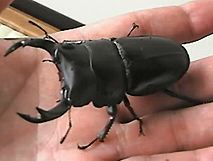
These beetles have become more rare, so shops have started selling them at pretty high prices. In the logic of the item description, then, the stick attracts these hard-to-catch beetles along with pretty girls, who are also hard to catch. Its ability to fascinate and magnetically attract rare things makes it “mysterious.”
I don’t know what additional powers might attend the weapon. Going along with the item description, it might allow for a higher rare item drop-rate. Anyway, SegaGaga has a lot of material whose meaning lies beyond the words, so Sega may have declared the cultural hurdles insurmountable.
We, of course, disagree. At the time of our most recent draft, the description reads: “A mysterious stick with the power to attract hard-to-catch things such as rare beetles, pretty girls, etc.” While beetles may seem felicitous as one of the things described as worth catching, the relationship between beetles, girls, and the stick itself remains preserved. That’s the important part.
Getting our translations prepared for Patrick has required my adoption of new work methods. The Dreamcast code surrounding the text includes calls for background images, sometimes voice-acting clips, line and paragraph breaks, as well as the colors used for the text. These color codes are pretty important, since the game graphically distinguishes between speakers according to the color of their dialogue text. I have to prepare our translation materials with those codes attached to the appropriate text.