
This is an edited version of a blog post that originally appeared on 11/08/2006.
Quia melius fuerat bona non incipere, quam ab his, quae coepta sunt, cogitatione retrorsum redire, summo studio, dilectissimi filii, oportet, ut opus bonum, quod auxiliante Domino coepistis, impleatis.
Bede, Historiam Ecclesiasticam Gentis Anglorum
My very dear sons, it is better never to undertake any high enterprise than to abandon it once begun.
Bede, Ecclesiastical History of the English People
SegaGaga‘s localization has slowed somewhat, but we’re still moving forward. Many people have eMailed me due to the lack of updates on this blog, and I’d like to assure everyone that everything’s still on.
Let me briefly survey the work before and behind us. SegaGaga‘s text lies in two places on the disc: first, in twelve Message Files and, second, in the main data file. The Message Files contain texts that belong neither in the cutscenes nor in the RPG segments, and the main data file contains the texts used in shops, the RPG segments, and elsewhere. The amount of text in the main data file far outweighs the text in the Message Files, perhaps holding up to 90% of the total material. We have worked all of the Message Files into either first or second drafts. I’m currently working these texts into their second and third drafts.
In this entry, I want to explain my editorial approach to the third and later drafts. I’ve derived my approach from my experiences with games translated into English and my experiences writing poetry. I’ll need to digress to introduce how this impacts our work on SegaGaga.
I think that videogames could benefit from more conscientious, more masterful uses of language. I don’t think this on principle alone, but because most narration in videogames–both in cutscenes and gameplay–resembles theater in more ways than it resembles film. The authorial control of the camera presents the illusion of a videogame being identical to film; yet, in games from the past two console generations, players have shifted the camera much as the house audience can change seats for a better view. Even the wrong camera position can reveal a polygonal limbo that breaks the fantasy, much as an accidental peek into the left wing shows the technical work that supports a play’s illusion. Also, importantly, motion actors must conduct themselves more as stage players than film stars. They emote with body language rather than facial tricks, and they must carry the character in all their limbs at all times.
And here is where my trains of thought match tracks. As long as many of the dominant narrative qualities of videogames tend toward theatrics instead of professional film, why not make the language theatrical rather than perfunctory?
I want to explore that possibility with SegaGaga.
Crafting poets pump soul into the poems mostly with vowels. Consonants are important too, but they work best when they correlate with vowels that, in turn, correlate with other vowels. This is how a poem sings.
The traditional range of poetic vowels runs along a scale of fifteen sounds. Starting with the sounds that begin in the back of the throat and then moving to those that start near the teeth, they are: cool, don’t, wood, brought, cord, boy, ouch, far, hot, but, burr, fat, tend, hit, night, blame, and bee.
Say those sounds aloud, and you might feel the vibrations ascend to your lips. I use the word “might” because dialectical variations make the perfect mapping of these sounds difficult. My own Southern dialect shifts certain sounds up or down my throat, especially with our plenitude of diphthongs, so actual mileage may vary.
Those regional discrepancies aside, a line from William Blake illustrates how they work together: “Truly, my Satan, thou art but a dunce!”
The line starts with high vowels (Truly, my Satan) and then descends to the end (but a dunce!) Say it aloud, and you swallow the vowels. Along with the alliteration at the end, the line ends with a linguistic version of a comedian’s rimshot.
But a dunce! But a dunce! But a dunce!
The sounds support the meaning. Satan has been mocked.
Many translations of Japanese games seem to have been written without knowing that the words will eventually land in a voice actor’s mouth. The words seem to have been drafted as mere things on a page. Given the final need that a translation must fill, I don’t think it’s enough to translate only the meanings of the original Japanese text. Someone–either the translator or an editor–needs to become intimate with the characters and write their lines so that the sounds support their personalities.
At the very least, it will make work easier for the eventual voice actor.
I’ll provide two examples of how I’ve started to draft the characters. The examples provided here are by no means final; they are my first steps toward a solid editorial draft. I present them as illustrations insofar as they have partially moved the text closer to my ideal.
Here are my personality associations for Alisa: cheerful, emotive, moe, emotionally transparent, and respectful of order. These qualities remind me of Desdemona from Othello, so I analyzed the vowel patterns used in her speech as a template for writing Alisa.
I chose these lines (among others) for a sample of Desdemona’s speech:
My noble father,
I do perceive here a divided duty.
To you I am bound for life and education;
My life and education both do learn me….
Here’s what the vowels in these lines look like on a chart. Higher points indicate higher sounds (such as perceive, divided, duty, and life).
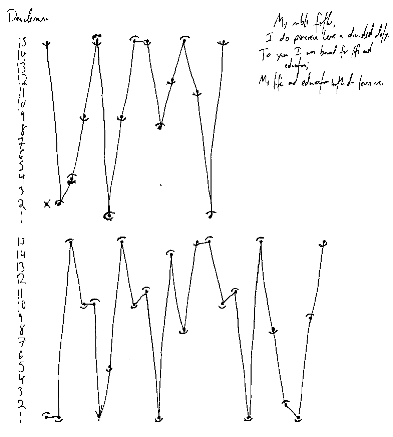
Desdemona’s speech lays her character bare–or, at least, it reveals her personality when she’s around her father. She pushes the sounds from the back and middle of her throat all the way to her teeth. Her words support her femininity, since higher, soprano notes are typically related most with the pitch of women’s voices. All her speech swells toward the dutiful womanhood that her father expects.
I have re-drafted Alisa’s lines according to this pattern. Perfect emulation isn’t possible due to the fact that I, as an editor, am limited to the ideas expressed in the original text. (When writing a poem, the words must change the idea as much as the idea gives rise to the words.) The point isn’t to replicate Desdemona in Alisa, but to use Desdemona’s pattern as a kind of starter’s kit.
I have mined for synonyms when I have noticed too many successive low vowels. I have rearranged the word order to suit the rhythm and vowel patterns. Above all, though, I have worked to make it coherent, uncontrived, and true to the original text.
For comparison, then, read the following second and third drafts of one of Alisa’s lines.
Second Draft
We just learned that Dogma released a new game on 7-18-2025. I’ve analyzed it with the TerraDrive. Here, read the results.
Third Draft
It’s 7-18-2025. Dogma just released their scheduled title. I’ve used the TerraDrive to break the game down. You can read our results here.
Here’s a side-by-side comparison of how the vowel patterns changed between the two drafts.
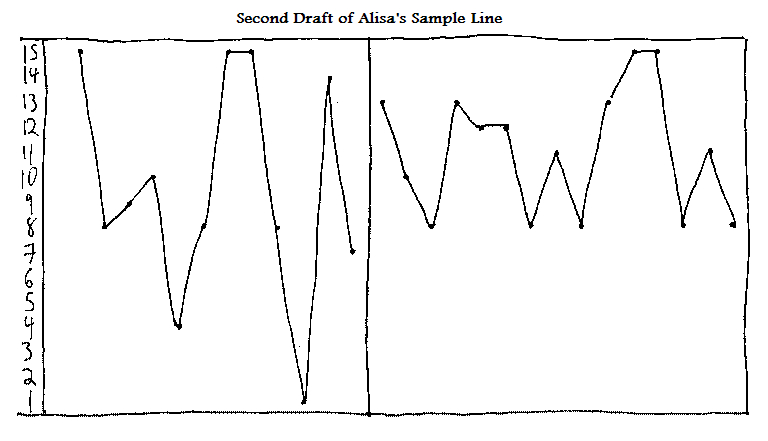
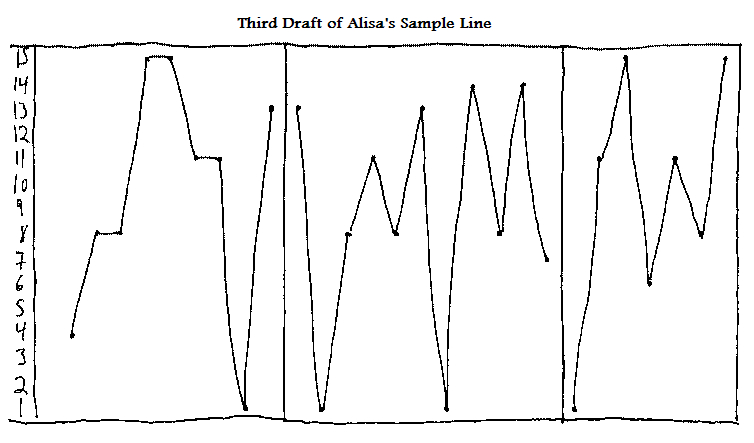
Notes on the changes
- I placed the numeric date at the beginning of the line. The numbers can be spoken, but they’re not words to the eye. The reader has to shift his focus from the narrative flow in order to comprehend those numbers. The hesitation becomes less obtrusive if they’re given at the start.
- Alisa now pushes her words from lower sounds to higher sounds. For now, I think I’ve chosen good words for the sense of the text. Alisa vacillates between coy and officious tones, and the sample text catches her during one of her official duties.
- Certain words have a set rhythm and sound that cannot be changed, such as “Dogma” and “TerraDrive.” Luckily, both words fit into the iambic meter that I have used for Alisa’s lines.
- I’ve substituted “break the game down” for “analyzed.” It supports the rhythm and sounds, and it fits her character at that given moment. The phrase overlaps her casual and officious tones. She is delivering an official message, and she is getting ready to engage the player’s character in work. She takes a tone of personal familiarity (moe on the clock) when she corroborates with the player’s character.
Now let’s look at the Dogma Chief’s voice. (Dogma is Sega’s corporate rival in SegaGaga.)
Here are my associations with him: dominating, ambitious, contemptuous of weakness, conniving, and (as per Yoshiko’s note) “one who speaks like a samurai chief.” These qualities remind me of Gloucester from Richard III, so I likewise analyzed the vowel patterns used in his speech.
Here’s the opening of his most famous soliloquy:
Now is the winter of our discontent
Made glorious summer by this sun of York;
And all the clouds that lour’d upon our house
In the deep bosom of the ocean buried.
Here’s what the vowels in these lines look like on a chart:
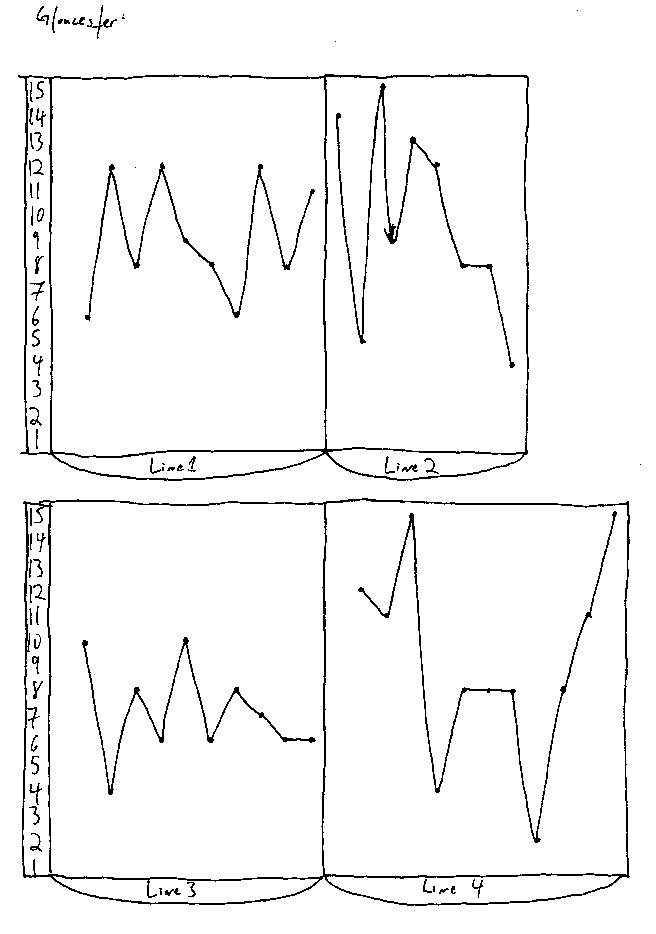
As with Desdemona, the vowel patterns support the character. Gloucester’s tones stay mostly in the middle range, expressing a calmness that concords with the rational gears of a sociopath’s mind. The on-beats of his iambs mostly rise from lower off-beats in his first line, yet his subsequent lines stress descending sounds. Rising on-beats connote optimism; his first line was ironically pleased. Descending on-beats connote a lower mood, and the majority of his lines show that his spirits follow the clouds’ descent into the ocean.
From Gloucester, then, I derived my template for the Dogma Chief. I decided that most of his on-beats should descend, and, while allowed occasional high tones, he should always return to the middle range.
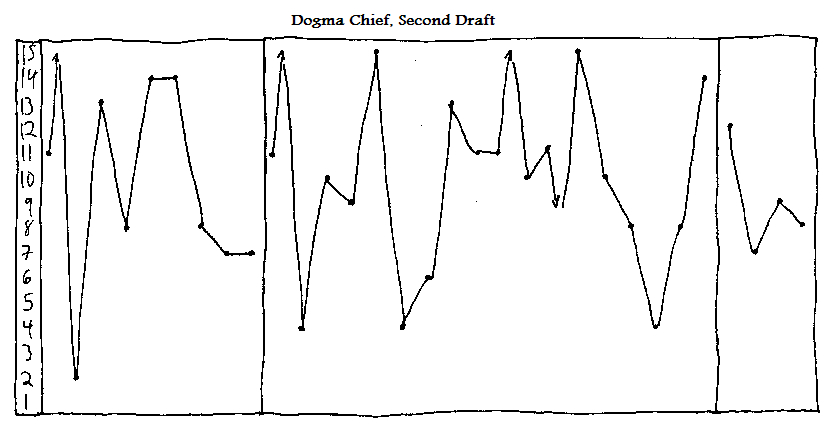
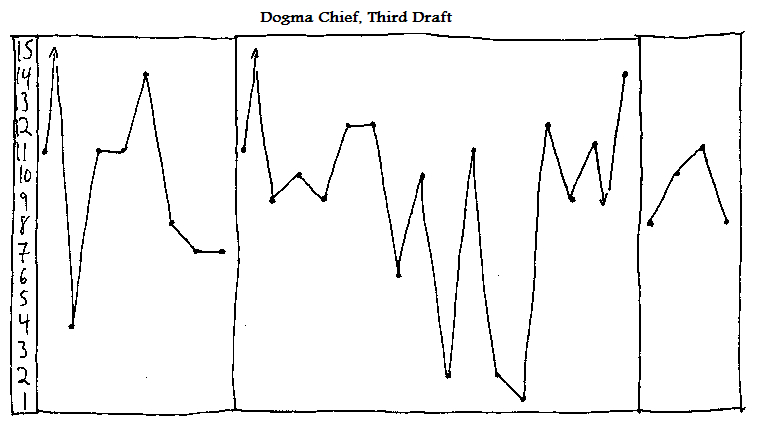
Here are the second and third drafts of one of his lines:
Second Draft of the Dogma Chief’s Line
They go by the name SegaGaga. They crawl as worms before our might, yet they gnash their teeth at us all the same. Intolerable!
Third Draft of the Dogma Chief’s Line
They call themselves SegaGaga. They stir as worms within our shadow, yet those fools still bare their fangs? Unacceptable!
Here’s how these versions compare graphically:
Notes on the changes
- The word “SegaGaga” presents a special problem for the Dogma Chief’s template. The rhythm of the word emphasizes syllables that ascend tonally: SegaGaga. Here’s where lessons learned writing formal poetry come in handy: let the form dictate the poem. In this case, the rhythmic demands of the word “SegaGaga” craft the Dogma Chief’s voice more than Gloucester’s template.
- I brought most of the higher tones down from their stratospheres in the second draft, and I shortened the length of the lines. This keeps the Dogma Chief from using too many feminine sounds; it gives him more descending on-beats; and it keeps his speech more blunt.
- The middle of the second sentence in the third draft breaks from the Dogma Chief’s form. The on-beats ascend tonally (our shadow, yet), then correct themselves (those fools still bare), and then revert to an ascending on-beat (their fangs).
Inasmuch as a character’s usual speech should support his demeanor, the form can be broken when the character’s spirit breaks from his normal disposition. I think the formal break works. The Dogma Chief’s indignation suggests a crack in the surety of his schemes.
- I am more dissatisfied with the third draft of the Dogma Chief than I am with Alisa’s third draft. I’ve been hung on a sense of loyalty to the sounds upon which I’ve decided to base his voice.
I’ve seen a consistent pattern emerge in the Dogma Chief’s voice while I’ve drafted him rhythmically and tonally. His character might be an instance when the character rejects the template and finds his voice in self-defense.
In this case, fidelity to a pre-conceived ideal is not important. An abusive father gives his child a sense of identity if the child reacts against his patriarch’s demands, but there’s still no need to torture the kid.
- “Stir as worms within our shadow” is sexier than “crawl as worms before our might.”
- On the subject of worms, I thought that the former image of worms baring their teeth was a badly mixed metaphor. I tried to smooth the problem without altering the contents of the text. I shrank the teeth to fangs and gave the second half of the compound sentence a new subject (“fools”) instead of a pronoun (“they”) that has “worms” as its antecedent. I think this should deflate the absurdity.
I’m working with each character in turn. In order to become more intimate with each personality, I’m drafting all of his or her lines while ignoring the other voices. They’ll all fit together in the end. Getting to know the principal players through the Message Files will make encountering them in the main data file easier.
This is going to be really, really good.
Hence the vanity of translation: it were as wise to cast a violet into a crucible that you might discover the formal principle of its colour and odour, as seek to transfuse from one language into another the creations of a poet. The plant must spring again from its seed or it will bear no flower–and this is the burthen of the curse of Babel.
Percy Bysshe Shelley, “A Defence of Poetry”